
Nonwovens Glossary of Terms
This glossary includes all nonwoven terms and many of those in related industries where nonwovens are converted. The information is easy to digest with considerable cross-referencing of terms. Also included are numerous illustrations of various nonwoven technologies to clarify descriptions.
This glossary can help those working within the industry and academics to familiarize themselves with the nonwoven nomenclature. Should you wish to add, amend, update a term, we’d enjoy hearing from you. Please email us your comments at info@inda.org.
A
Abrasion
The wearing or grinding away of any part of a material by mechanical action.
Abrasion resistance
The ability of a surface to resist wear by friction.
Absorption
A process in which one material (the absorbent) takes in or absorbs another (the
absorbate). The liquid or a gas is absorbed into a porous substance and retained.
Accumulator
A temporary storage device used in a fabric production line that enables the line to
continue producing fabric while the full wind-up rolls of fabric is doffed and replace by an empty wind-up roll. In
operation, the fabric is festooned over a series of rollers placed on the floor and above on an elevator type
device. This accumulator is positioned between the production line output and the fabric windup. During doffing,
when no fabric is being wound up, the elevator device starts to rise from the floor taking up the fabric output from
the production unit. (See JBox as an example of another system.)
Acetate fibers
A manufactured fiber in which the fiber-forming substance is cellulose acetate
(Federal Trade Commission (FTC) definition). Acetate fibers are derived by treating pure cellulose, which has been
extracted from vegetable matter and generally wood pulp or cotton linters, with acetic anhydride. The resulting
product is dissolved in acetone and extruded into filaments and the acetone evaporated. Acetate fibers are
moderately strong, generally soft and lustrous like rayon. Acetate staple and filament fibers are more commonly used
in weaving operations supplying end-markets such as lingerie, blouses, dresses, men’s ties and other apparel.
Acetate consumption by the nonwoven industry is relatively low.
Acetone
Colorless liquid used as an organic solvent.
Acquisition and distribution layer, (also referred to as sub-layer)
A nonwoven wicking layer
under the top sheet (or face fabric) of an absorbent product, which speeds the transport and distribution of fluids
throughout the absorbent core.
Actinic degradation
Deterioration of physical and aesthetic properties of fibers and fabrics due
to exposure to light.
Activated carbon
A form of carbon capable of removing certain gases from air or impurities from
water. Carbon is obtained from certain materials, generally of vegetable origin, and activated to produce a porous
structure with a large surface area and adsorptive properties.
Additives
Chemicals added or incorporated into materials to give them different functional or
aesthetic properties, such as flame retardancy and softness.
Adhesion
The force that holds different materials together at their interface.
Adhesive migration
The movement of adhesive in a fabric during drying or curing, to give it a
non-uniform distribution within the web-usually increasing to the outer layers.
Adsorbent
It is the material to which a molecule is attached and retained.
Adsorption
The attraction and adhesion of gaseous or liquid molecules to the surface of a solid.
The strength of the bond depends on the van der Waal forces between two molecules.
Aerosol
Small particles, solid, semi-solid or liquid suspended in the air. The diameter of the
particles may vary from 100 microns down to 0.02 microns. Examples are dust, smoke and fog.
Aesthetics
Properties of fabrics perceived by touch, sight, smell and sound. Examples are hand,
drape, texture, rustle, color and odor.
Afterglow
The flameless, ember-like burning of a material after the external ignition source is
removed.
After treatment (Finishing)
Chemical or mechanical processes carried out after a web has been
formed and bonded to enhance functional or aesthetic properties. Examples are embossing, crêping, softening,
printing and dyeing. The term also includes slitting to narrower widths and rewinding to desired roll lengths.
Agglomeration
A cluster of particles or fibers.
Aging
Processing in which products are exposed to environmental conditions, that stimulate real
use or accelerated use, for the purpose of determining their effect on the functional and aesthetic properties of
the products.
Air filter
A device for removing contaminants from an air stream.
Air forming
See Air laid.
Air laying, Air laid process
A nonwoven web forming process that disperses fibers into a
fast-moving air stream and condenses them onto a moving screen by means of pressure or vacuum.

Air laid nonwoven
An air laid web that has been bonded by one or more techniques to provide
fabric integrity.
Air laid web
A web of fibers produced by the air laid process.
Air laid pulp
An air laid nonwoven that is produced with fluff, wood pulp. The web can be bonded
with resin and/or thermal plastic resins dispersed within the pulp.
Air permeability
The rate at which air flows through a fabric.
Amorphous
Not crystalline. A random, rather than regular, arrangement of chains of molecules
within regions of a polymer or fiber.
Anionic compound
A chemical carrying a negative electrical charge.
Anisotropic
Not having the same physical properties in every direction. In the plane of a fabric,
it is related to a non-random distribution of fibers.
Antifelting agents
Products that minimize matting of textile materials.
Antifoaming agent
An additive that minimizes the formation of bubbles within or on the surface of
a liquid by reducing the surface forces that support the bubble’s structure. See Surface
Tension.
Antioxidant
An additive that retards the deterioration of a material’s functional and aesthetic
properties resulting from its reaction with the oxygen in air.
Anti-soiling properties
The ability of a textile to resist the deposition of dirt, making it easy
to remove the dirt. Anti-staining is a similar ability for oil or waterbound stains.
Antistat
An additive that reduces the accumulation or assists the dissipation of electrical
charges that arise during the processing of fibers, fabrics and films, and during the use of products.
Arachne machine
A machine that stitchbonds a nonwoven using a knitting stitch.
Aramid fiber
A synthetic fiber made from a long chain of synthetic polyamide molecules. There are
two main fiber types: polyamide 6, usually marketed under the Perlon name and polyamide 6.6 (often referred to as
66) referred to as Nylon. Other types of polyamide fibers have developed, but volumes are low. The numbers indicate
how many carbon atoms are in each basic molecule of which the polyamide is made. Aramids were the first synthetic
fibers developed: polyamide 6 in Germany and polyamide 6.6 in the United States. The main physical properties of
aramid fibers are high strength, abrasion resistance, good elasticity and resistance to many solvents.
ASHRAE
The acronym for American Society of Heating, Refrigeration and Air Conditioning Engineers.
Most air and liquid filter manufacturers in the United States use the ASHRAE test methods. Filter producers and
consumers in many countries around the world follow the ASHRAE procedures.
Asphalt overlay
A type of geotextile fabric used in the resurfacing of older roads. In the
process, the old layer of road has a layer of tar sprayed on the surface and then the nonwoven asphalt overlay is
put on top of the surface while it is still tacky. Subsequently, a new asphalt surface is layered on top. The
nonwoven’s purpose is to prevent water from seeping from below the surface to degrade the surface and to spread the
load of cars and trucks to a wider area.
ASTM
The acronym for American Society for Testing and Materials International.
B
Back coating
An adhesive type substance applied to the back side of a fabric for the purpose of
locking pile yarn into a carpet backing, or bonding a secondary backing to the primary backing, or increasing fabric
body or stiffness.
Backing
A web or other material that supports and reinforces the back of a product such as
carpeting or wallpaper.
Back sheet
The exterior surface of a baby or adult diaper – generally made of film. The current
trend is to improve absorbent products’ aesthetics by adding a nonwoven material to cover the film, giving the
outside of the product a cloth-like hand.
Bacteriostat
Chemical additive that limits or prevents the growth of bacteria.
Bale
A compressed and bound package of fiber – the common shipping package for fibers.
Bale breaker
Opening equipment used to break open compressed bales of fiber into separated fiber
clumps in preparation for carding.
Barrier leg cuff
The raised cuff, which is generally a hydrophobic cover stock, used in baby or
adult diapers and designed to contain body waste in the core area.
Basis weight
The weight of a unit area of fabric. Examples are ounces per square yard and grams
per square meter.
Batt
A collection of fibers assembled into a sheet suitable for needlepunching. The term is
synonymous with web.
Batting
A soft, bulky assembly of fibers usually used for filling, formed by carding, garnetting,
air laying or other means. Layered carded webs are sometimes called a batt.
Beam
In the context of the spunlaid technology, the term refers to the large beam that contains
the fiber spinning dies. In textiles, the terms refer to a large spool containing many separate fibers wound
parallel to one another for use in warp knitting or weaving.
Beater
The machine that does most of the fiber separation and cleaning in the processes of
picking and opening that occur before the fiber is made into a web.
Bicomponent fibers
Fibers made of two different polymers extruded into one filament (core within
a sheath or side by side are examples). One type of bicomponent fiber is produced using two polymers so chosen that
one component softens at a lower temperature to act as a binder while the other component maintains the web’s
structural integrity. A second type of bicomponent fiber is splittable and with some form ofmechanical energy
applied, such as the hydroentangled technology, will separate into finer denier fibers.
Binder
An adhesive substance used to bind a web of fibers together or bond one web to another.
The adhesive can be in a solid form (powder, film or fiber), foam, or in liquid form (emulsion, dispersion,
solution) to bond the constituent elements or enhance their adhesion.
Binder content
The weight of adhesive used to bond the fibers of a web together – usually
expressed as percent of the fabric weight.
Binder fiber
Fibers with lower melting points than other fibers with a higher softening point or
non-melting fibers. Upon the application of heat and pressure, these fibers soften and adhere to other fibers in the
web, thereby acting a binder. Some binder fibers can be bicomponent. A solvent (e.g. water) can activate some binder
fibers, which may not be thermoplastic.
Biodegradable
The ability of a substance to be broken down by bacteria.
BLC
See Barrier Leg Cuff.
Bleaching
Chemical treatment with compounds that release chlorine or oxygen to increase the
whiteness of fibers and fabrics.
Blend
A combination of two or more fiber types in making yarn or fabrics.
Boardy
The quality of stiffness in describing the hand of a fabric.
Bonding
The process of combining a fibrous web into a nonwoven fabric by means of resins (e.g.
adhesives or solvent) or physical (e.g. mechanical entanglement or thermal adherence). The bonding may be all over
or restricted to predetermined, discrete sites.
Bond strength
Amount of force needed to separate layers in a laminated structure or to break the
fiber-to-fiber bonds in a nonwoven.
Breaking length
The length of a strip of fabric or film whose weight is equal to the force needed
to break it. It is calculated by dividing the force needed to break by the basis weight.
Bristles
Fibers with thickness greater than about 100 microns (500 mils).
Brownian movement
The random movement of small particles or aerosols suspended in a fluid caused
by molecular bombardment and fluctuations about the particle.
Brushing
A finishing process where a system of spinning brushes with wire bristles lightly touch
a fabric and raise a light nap. This brushing process is more commonly used to finish woven and knitted materials.
Bulking
Processes that develop greater fullness, volume and crimp in yarns and fabrics.
Burning rate
The speed at which a fabric burns. This can be expressed as the amount of fabric
affected per unit time, in terms of distance or area travelled by flame, afterflow or char.
Bursting strength
The force needed to rupture a material by distending it with force or pressure.
C
Calender
A machine used to bond sheets of fabric or film to each other or to create surface
features on these sheets. It consists essentially of two or more heavy cylinders that impart heat and/or pressure to
the sheets that are passed between them. The rollers can be mirror-smooth, embossed with a pattern or porous.
Calendering
A mechanical finishing process used to laminate and to produce special surface
features such as high luster, glazing and embossed patterns.
Calender bonding
Thermally bonding a web of loose fibers by passing them through the nip of a
pair of calender rollers, of which one or both are heated. Plain or patterned roller may be used (see Point Bonding).

Capacity
In terms of production, it is the maximum production output a machine is designed to
deliver.
Card
A machine designed to separate fibers from impurities, align and deliver them to be laid
down as a web or to be further separated and fed to an air laid process. The fibers in the web are aligned with each
other predominantly in the machine direction. The machine consists of a series of rolls and drums that are covered
with many projecting wires or metal teeth.
Card clothing
The wire teeth or serrated flutes that cover the working surfaces of a card.
Carded nonwoven
A nonwoven produced from a carded web that has been bonded by one or more
technologies to provide fabric integrity.
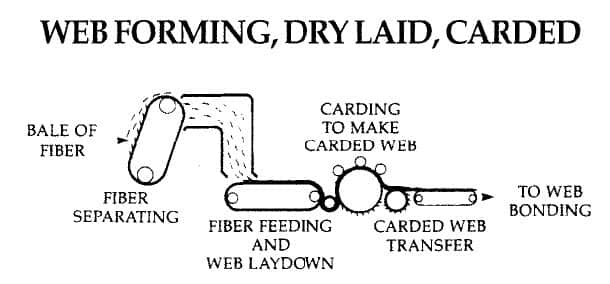
Carded web
A web of fibers produced by carding.
Carding
A process for making fibrous webs in which the fibers are aligned essentially parallel to
each other in the direction that the carding machine produces the web (see Machine
direction).
Carpet
All textile floor coverings that are not designated as rugs.
Carpet backing
Support sheet on the back of a carpet through which the tufts are inserted or
adhered. Primary backing is the principal material that holds the tufts. Secondary backing
is occasionally applied on the underside of some carpeting to lock in the tufts and improve abrasion
resistance, dimensional stability and strength.
Carpet underlay
A separate fabric that provides cushioning for the carpet.
Carrier web
A fabric which supports and facilitates moving a fibrous material through a
processing stage.
Cartridge Filter
A disposable filter media which is generally long and cylindrical which is
placed in a sealed filtration receptacle. The contaminated fluid flows from the outer edge of the filter to the
inner hollow core on exiting but leaves it particles in the cartridge media.
Catalyst
A chemical that changes the rate of a chemical reaction, usually to speed it up, and is
not consumed.
Cationic
A chemical carrying a positive electrical charge.
Cellulose acetate fibers
See Acetate Fibers.
Cellulosic fibers
Made from plants that produce fibrous products based on polymers of the
cellulose molecule. Cotton plants produce separate cellulose fibers. Wood pulp is made by mechanically and
chemically separating wood fibers. Rayon is made by dissolving vegetable matter, generally wood pulp, in a solution
and extruding the solution through spinnerets into a chemical bath that regenerates the filaments. Some other
cellulosic fibers are flax, jute and ramie.
CEN
Acronym for the Comité Européen de Normalisation or the European Committee for
Standardization. This is a committee that is charged with the responsibility to standardize the testing procedures
of various European member nations.
Char
The flame affected part of a fabric after it has been burned.
Chemical bonding
See Resin Bonding.
Chemical finishing
Processes that apply additives to change the aesthetic and functional
properties of a material. Examples are the application of antioxidants, flame retardants, wetting agents, and stain
and water repellents.
Chemical properties
The response of a fiber to chemical environments such as acids, bases, or
solvents.
Chips
Feed stock in the form of pellets or granules. Examples are polymers used in fiber or
spunlaid production, wood pulp used in rayon production and wood chips used to make pulp.
Chlorine retention
The tendency of fabrics to retain chlorine after bleaching.
Civil engineering fabrics
See Geotextile.
Clean room
An enclosed space or room with a ventilating system that cleans the air and reduces
the concentration and size of airborne particles to certain levels.
Clothing
When used to describe a card or garnett machine, the term refers to the sawtooth wire
covering that “clothes” the cylinders and combs the fibers.
Cloudy web
An uneven or irregular web that gives a cloud-like appearance.
Clump
A knot of fibers in a web resulting from improper separation of the fibers.
Coagulation
The precipitation of particles from their suspension in a liquid.
Coalescence
In a liquid-liquid dispersion, it is the joining together (or coalescing) of liquid
particles to form larger drops.
Coform
The formation of a nonwoven web through the concurrent use of elements from at least two
different web formation technologies.
Coating
Application of a liquid material to one or both surfaces of a fabric, which is followed
by drying or curing.
Cohesion
The resistance of like materials to be separated from one another. Examples are: The
tendency of fibers to adhere to each other during processing, the resistance of a web to being pulled apart, and the
resistance of a component of a laminate to being torn apart when the adhesive interface in the laminate is being
stressed.
Coir
Fiber derived from the outer husks of the coconut.
Colorfastness
The ability of a textile material to retain its color when exposed to conditions
(washing, drycleaning, sunlight, etc.) that can remove or destroy color.
Combing
In carding, the part of the process that removes neps and straightens the fibers.
Comfort
The sense of well-being in wearing clothing that comes from characteristics such as hand,
breathability, softness, light weight and warmth.
Commissioning
Term refers to the period of time during which a new production line goes through
the various stages of bring it into commercial production. Some complicated technologies can take several weeks:
checking electronics, hydraulics, metering systems, balancing drive systems, adding fiber or resins, etc.
Composite material
Combination of two or more distinct materials having a recognizable interface
between them.
Composite nonwoven
Term used when the essential part of the composite can be identified as a
nonwoven material. If the essential part cannot be identified, the term composite nonwoven is used when the mass of
the nonwoven content is greater than the mass of any other component material.
Condensation
Liquid or droplets that form when a gas or vapor is cooled below its dew point.
Contaminant
Any solid, liquid or gas which can adversely affect machinery, a system or person.
Conditioning
A process of allowing materials to reach equilibrium with the moisture and
temperature of the surrounding atmosphere. The atmosphere may be a standard such as 65 percent relative humidity and
70 degrees Fahrenheit, for testing purposes or other conditions that are optimum for manufacturing or processing.
Contact angle
The angle between the face exposed to air of a drop of liquid and the material on
which it is resting. Small angles, presented by flattened-out drops, indicate greater wettability of the material by
the liquid. Large angles, presented by rounded drops, indicate repellency.
Continuous filament
See Filament Fibers.
Corona charge
An electrostatic charge applied to some filter media to increase the initial
filtration properties of the filter (see Electret).
Converter
An organization that takes nonwoven fabrics supplied in rolls and provides and an
intermediate processing step, such as slitting, dyeing, coating, chemical finishes and printing. The fabric is then
shipped to the finished products manufacturer.
Cover
The degree to which a fabric hides an underlying structure.
Cover stock
A lightweight nonwoven material used to contain and conceal an underlying core
material. Examples are facing materials that cover the absorbent cores of diapers, sanitary napkins and adult
incontinence products. The term cover stock now refers generally to facing material (top sheet), barrier leg cuff,
back sheet, acquisition/transfer layer and stretchy panels.
Creep
The increase in strain exhibited by a material when held at constant stress.
Crepe
A quality in a fabric imparted by wrinkling or embossing to give crimped surface and
greater fabric bulk.
Crimp
The waviness of a fiber. Crimp amplitude is the height of the wave with
reference to straight uncrimped fiber. Crimp frequency or level is the number of crimps per inch or
centimeter. Crimp energy is the work needed to straighten out a crimped fiber. Crimp
percent is the length difference between the crimped and stretched out fiber expressed as a percent.
Crimp retention/stability
The ability of a fiber to maintain its crimp.
Cross machine direction
The width dimension, within the plane of the fabric, that is
perpendicular to the direction in which the fabric is being produced by the machine.
Cross laid nonwoven
A cross laid web that has been bonded by one or more techniques to provide
fabric integrity.
Cross laid web
A web of fibers formed by cross laying process.
Cross lapping
Process of layering a carded web on a conveyor, moving at right angles so the
fibers are oriented in the cross direction increasing the cross directional strength of the fabric and the web
weight.
Cross laying
Forming a multi-layered web on a conveyor belt by laying the web in a to and fro
pattern at right angles to the direction in which the conveyor belt travels. The orientation of the fibers is
dependent on the speed of the web delivery and the speed of the conveyor belt.
Cross laid web
A web of fibers formed by cross laying.
Cross-laid nonwoven
A nonwoven made from a cross laid web and bonded by one or more bonding
techniques.
Cross-linking
The chemical reactions that create bonds at several points between polymers. These
cause the polymers to be less soluble and to undergo changes in elasticity and stiffness.
Cross-section
The outline profile of a cut end of a fiber when it is cut perpendicular to its
long axis. These profiles can be round, oval, irregular or complex regular shapes – depending on the shape of the
die used to extrude the synthetic fiber, or for a natural fiber, depending on its growth pattern.
Crystalline
Orderly arrangement of molecules and polymer chains in a fiber or plastic.
CSR
The central supply room of a hospital from which supply items are distributed.
CSR wrap
The covering material wrapped around surgical instrument trays to maintain a bacterial
barrier in the hospital’s supply room storage area after sterilization.
Curing
A process by which resins, binders or plastics are set into or onto fabrics, usually by
heating, to cause them to stay in place. The setting may occur by removing solvent or by cross-linking so as to make
them insoluble.
Cylinder loading
The situation that occurs when fibers are imbedded so deeply in the wire
clothing on a card cylinder that they resist transfer to the doffer cylinder according to the normal fiber path
through the card.
D
Decitex (Dtex)
Weight in grams of 10,000 meters of a fiber. It is one-tenth of a tex (see
Tex).
Defoaming agents
See Antifoaming agents.
Degradation
Deterioration of aesthetic and functional properties of a product – usually after
being exposed for some time to heat, cold, light, or use.
Degree of polymerization
The average number of molecules (see Monomers) in a polymer.
Dehumidify
To remove water vapor from an airstream or from air in a space.
Delamination
Tendency of a fabric to be pulled apart (layer separation) by normal surface forces
or shear tensions.
Delustrant
An additive that is used to dull the luster and to increase the opacity of a fiber or
a fabric. The degree of delustering is termed semidull, dull and extra dull, depending on the amount of pigment
added.
Denier
The measure of a weight per unit length of a fiber. Denier is numerically equal to the
weight in grams of 9,000 meters of the material. Low numbers indicate a fine fiber sizes and high numbers indicate
coarse fibers sizes. The tex system is used in countries outside the United States. A tex
is numerically equal to the weight in grams of one kilometer of fiber. It can be calculated by dividing the
denier by nine.
Depth filter
A filter medium which is thick and captures particles within the media.
Diatomaceous earth
A filter media made from diatoms, which are fossils that collect at the bottom
of sea beds in prehistoric seas. Also known as “kieselguhr,” the material is characterized by pores and cavities
capable of capturing and retaining contaminants.
Diffusion
The movement of molecules or ions through a solution or material in response to
differential concentrations or repulsive or attractive forces.
Dimensional stability
The ability of a fabric to maintain or resume its original geometric
configuration.
DIN
Deutches Institut fur Normung or The German Institute for Standardization, which establishes
standards for classifying and testing filters.
Dipping
Immersion of a textile in a finishing liquid (dip) such as dye, binder
softener to improve its adhesion or water repellent.
Dispersion
A distribution of small particles in a medium. It also describes the uniform
suspension of fibers in water for wet forming.
Dispersability
The ability of a product to readily break apart due to physical forces.
Disposables
A general classification of end-markets where the product made from the nonwoven has
a relatively short life. Examples of some of the major categories are cover stock for baby diapers and sanitary
napkins, wipes, fabric softener, medical apparel and associated items and filters.
Doff:
- (verb) The term used for removing a finished fabric from the machine: Doff the roll, or Doffing the roll.
- (noun) In some regions, the term also refers to the roll of finished material removed from the machine.
Doffer
The last cylinder of a card that takes the web of fibers that has been formed and removes
it by a combing process (doffer comb) or rolls.
Doffer comb
An oscillating comb that is positioned close to the doffer roll to strip the
travelling web away from the card.
Doffer loading
Refers to fibers firmly fixed or plugging the doffer roller’s wire preventing the
doffer comb from removing the web.
DOP
Dioctylphthalate (diethyhexyphospate) is a viscous liquid that is heated into an aerosol in
the critical particle range to challenge a filter. The aerosol’s presence upstream of the filter and downstream are
measured to determine the media’s efficiency. DOP is used to measure HEPA and ULPA media performance.
Drape
The ability of a fabric to fold on itself and to conform to the shape of the article it
covers.
Draw-through
An air circulating fan located downstream of the heating or cooling coils,
humidifiers and filters in an HVAC system.
Drawing
A process of stretching a filament after it has been formed so as to reduce its diameter.
The ratio of the final length to the initial length is called the draw ratio. Controlled stretching
of the filament by a factor of 4 to 10 causes the molecular chains to become aligned (oriented) along the fiber axis
and makes the filament stronger.
Dry spinning
The process in which a liquid polymer solution is passed through spinnerets into a
heated air stream that drives off the solvent and coagulates the polymer into fibers. Sometimes referred to as
Solvent Spinning.
Dry forming or dry laying
A process for forming a web from dry fibers by using carding equipment.
Air laying refers to the formation of random webs with a stream of air.
Dry laid nonwoven
Dry laid web of fibers that has been bonded by one or more bonding techniques
to produce a fabric with integrity.
Dry laid web
A web of fibers produced by the dry laying process.
Dry scrubbing
The process of removing heavy concentrations of gaseous contaminants from an
airstream by the use of some specially designed adsorbers or chemisorbers.
Drying cylinders
Drying cylinders are used by the resin bonded process. The wetted, loose web is
passed over the heated revolving cylinders to drive off the water leaving the cured resin that bonds the web.
Dumbbells
Defects common to wet-formed nonwovens, in which a “long” fiber entangles clumps of
“regular” fibers. Typically, clumps are found at each end of the “long” fiber, giving it the appearance of a
dumbbell.
Durables
A general classification of end-markets for nonwoven materials. The main characteristic
of these markets is that the end products have a long life and are more or less permanent. The larger of these
markets include apparel interlining, automotive, home furnishings and bedding construction materials, carpeting,
geotextiles and roofing material markets. See also Long-Life products.
E
Efficiency
The ability of a filter device or media to remove particulate of a certain size from a
liquid or gaseous fluid by measuring the concentration of the particles upstream and downstream of the device or
media.
Elasticity
The property inherent within a material to recover to its original shape after the
force deforming the material is removed.
Elastomers
Polymers having qualities of stretch and recovery.
Electret
A microfiber filter media in which the fibers have more or less permanent electrostatic
charge to attract and retain airborne dust particles. Electret filters can be reusable or disposable.
Electrical conductivity
A measure of the rate that an electrical charge travels from one point to
another in an electric field.
Electrical resistivity
The resistance to the movement of an electrical charge.
Electronic air cleaners
These air cleaners electrostatically charge airborne dust particles as
they enter the first stage of the device and then captures them as they pass through the second stage of the filter,
carrying the opposite electrical charge.
Electrostatically laid web
A web produced by an electrostatic process.
Electrostatic web forming or laying
Forming a web of fibers, especially microfibers, by means of
an electrostatic field from a polymer solution or emulsion, or from a polymer melt.
Elongation
The deformation in the direction of load caused by a tensile force. Elongation is
generally expressed as a ratio of the length of the stretched material as a percentage to the length of the
unstretched material. Elongation may be determined by the degree of stretch under a specific load or the point where
the stretched material breaks.
Elongation at break
The point at which the last component of the stretched material breaks
Embossing
A process whereby a pattern is pressed into a film or fabric, usually by passing the
material between rolls with little clearance, and where one or both rolls has a raised design. At least one of the
rolls is usually heated.
Emulsion
A suspension of finely divided liquid droplets within another liquid (see Dispersion).
Entanglement
A method of forming a fabric by wrapping and knotting fibers in a web about each
other, by mechanical means, or by the use of jets of pressurized water, so as to bond the fibers. See Hydroentangling.
Exhaust air
Air removed from a space and not reused.
Extrusion
A process by which a heated polymer is forced through an orifice to form a molten
stream that is cooled to form a filament or fiber. A solution of the polymer can also be forced through the orifice
into a solvent that causes the fiber to solidify.
F
Fabric
A sheet structure made from fibers, filaments or yarns.
Face area
The area of a media used in air or liquid filters.
Facing
An outer covering of a product that is exposed during use or is placed against the body.
Fan
A device using blades for moving or producing artificial currents of air.
Felt (Nonwoven definition)
A sheet of matted fibers, most often wool or fur, bonded together by
needlepunch and/or chemical processes and the application of moisture, heat and pressure.
Felt (Textile definition)
A woven fabric, generally made of wool, heavily shrunk or “fulled” by a
combination of moisture, heat, chemicals and pressure so as to make it almost impossible to distinguish the weave.
Fiber
A unit of matter characterized by a high ratio of length-to-width. Material which can be
spun into yarn or made into fabric by interlacing (weaving), interlooping (knitting), or interlocking (bonding).
Discontinuous fibers are referred to as “staple fibers” with lengths designated in inches or millimeters. Typical
textile fibers have length-to-width ratios in the order of 1000 to 1, are longer than one inch, have diameters
greater than 10 microns, and mass-per-unit-length (linear density) values in the order of one gram per thousand
meters.
Fiber distribution
In a web, the orientation (random or parallel) of fibers and the uniformity of
their arrangement.
Fiber variant
A man-made fiber type derived through the use of additives or modification of the
polymer chemistry or fiber surface. Fiber variants exhibit or emphasize specific properties and are intended for
focused end-uses or specialized applications. The modification may consist of adding end or side groups, to the
fiber forming polymer, altering spin finish, changing spinneret geometry, or varying any combination of controllable
manufacturing parameters.
Fiberfill
Low density fiber construction, used as filling and cushioning, for products like
pillows, apparel and quilts made from synthetic fibers. The most common fiber used for fiberfill purposes is virgin
polyester.
Fibrillate
The breakup of a plastic sheet into a fibrous sheet. The term also to breaking fibers
into smaller fibers, such as the splitting of a bicomponent fiber.
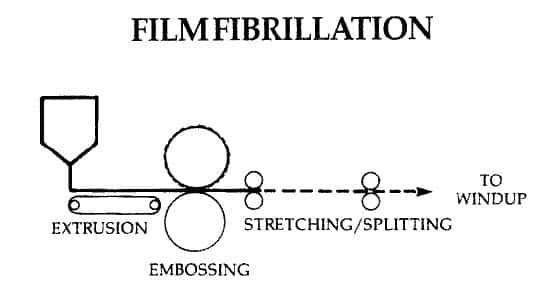
Fibrillated film
A type of fabric made from a process that embosses a film then stretches it in a
controlled manner in the machine and cross direction to break open the film into small holes (fibrillate). The
fibrillated film has a structure than resembles a fibrous nonwoven fabric. These materials can be used as cover
stock, facings for supporting other nonwovens or as supporting scrims.
Fibrous Assembly
A predetermined amount and arrangement of natural or manufactured fibrous
material such as, but not limited to fibres, continuous filaments, or chopped yarns of any length or cross-section.
It can be a planar (two-dimensional) or three-dimensional alignment of fibrous material.
Filament fibers
Filaments are extruded fibers produced from a variety of polymers. Filaments are
continuous fibers that are produced by forcing a molten polymer through a spinneret. If cut to a shorter length, say
3.8 cm, the term filament fiber changes to “staple” fiber.
Filament yarn
A yarn made of continuous filaments assembled with or without a twist.
Filler
A nonfibrous additive used in a fiber to increase its weight, replace more expensive
polymer or change luster and opacity. It is also non-fibrous materials, such as insoluble clay, gypsum, starch or
gum added to a fabric to increase its weight or appearance.
Filter fabric
A cloth used to separate particles from their suspension in air or liquids.
Filter media
Material that makes up the filter element. Media can be made of a variety of
materials, woven metal, sand, fiber, ceramics, etc.
Finish
Substance added to fibers and textiles, in a post-treatment, to change their properties.
Examples are lubricants and flame retardants.
Finishing
See After treatment.
Flame resistance
The property of a material to resist ignition, burn slowly or to self-extinguish
after the ignition source is removed.
Flame retardant
A chemical used to impart flame resistance. The chemical can be added at the time
the fibers in spun or added to the fabric though a finishing process.
Flammability
The characteristics of a material that describe the relative ease for a fabric to
ignite and sustain combustion.
Flammability tests
Procedures used to determine the flame resistance and flame retardant
properties of materials.
Flashspinning
A modified spunlaid technology in which a polymer/solvent solution is extruded
under conditions that rapid solvent evaporation at the spinneret occurs so that the individual filaments are
disrupted into a highly fibrillar form and are collected on a moving screen to form a web.
Flashspun nonwoven
Webs of fiber produced by the flashspinning method and bonded together by one
or more bonding techniques to provide fabric integrity.
Flashspun web
A web of fibers produced by the flashspinning process.
Flex abrasion
Abrasion of a sheet or fabric resulting from unidirectional flexing and frictional
passage over a bar or other wear surface.
Flexural rigidity
The resistance of a fiber to bending (fiber stiffness), defined as the couple
required to bend a fiber to unit radius of curvature.
Flocking
A method of applying a velvet surface to a material by dusting, or electrostatically
attracting, short fibers onto an adhesive coated surface. The short fibers are made by grinding or cutting.
Flushability
The industry has a rigorous set of flushability assessment tests for products that
may be labeled “flushable.” The seven industry tests provide a holistic assessment of physical and biological
material characteristics required for a product to be compatible with wastewater plumbing, infrastructure and
treatment.
The seven industry tests include:
- FG501.R1(18) Toilet and Drain Test
- FG502.R1(18) Slosh Box Disintegration Test
- FG503.R1(18) Household Pump Test
- FG504.R1(18) Settling Test
- FG505.R1(18) Aerobic Biodisintegration Test
- FG501.R1(18) Anaerobic Biodisintegration Test
- FG507.R1(18) Municipal Pump Test
For a product to be flushable it must:
- Clear toilets and properly maintained drainage pipe systems under expected product usage conditions;
- Be compatible with existing wastewater conveyance, treatment, reuse and disposal systems; and
- Become unrecognizable in a reasonable period of time and be safe in the natural receiving environments.
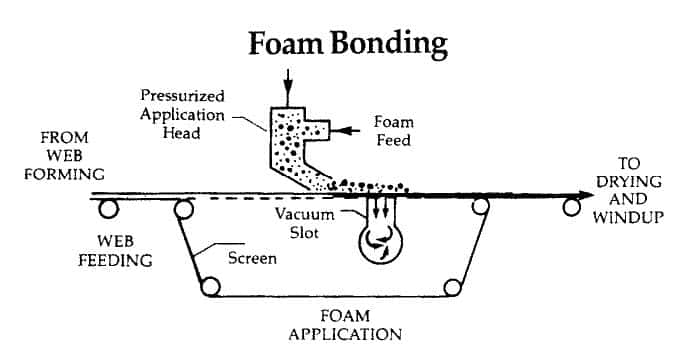
Foam bonding
A method for applying a resin to a loose web to bind the fibers. The resin is turned
into a foam which then coats the fibers. An advantage of foam bonding is that little to no water is used in the
binder thus requiring less heat energy and time to dry and cure the binder.
Foam machine
A machine used to generate foam. Foam is a means of adding a liquid to a web or
fabric. Foamed latex binders are added to unbonded webs foamed finishes, such as hydrophilic finishes for cover
stock are applied by this method.
Foam spreader
The devise used to spread the foam evenly across the width of the web.
Fog
An aerosol of fine liquid or semi-solid droplets in a gas.
Formed fabric
Another term for nonwoven fabric.
FPM
Feet per minute.
Fusing
Melting or bonding together of fibers or fabrics.
Fuzz
Untangled fibers that protrude from a fabric’s surface or yarn.
G
Garnett
The garnett is a fiber processing machine with a series of sawtooth wires that are much
coarser than found in a conventional carding system. The garnett process can reduce textile waste, old clothing and
assorted natural fibers to a fibrous feed that can be needlepunched.
Gas
A fluid having extreme molecular mobility and no fixed dimensions. It diffuses and expands
rapidly to occupy the space in which it is contained. It is the vapor or gaseous state of a substance.
Geogrid
A grid-like material made from various polymers with generally large openings. The
material is used to stabilize soil, control erosion and occasionally used as fencing.
Geotextile
A permeable fabric used in civil engineering construction projects such as paving,
dams, embankments and drains for the purpose of soil stabilization, sedimentation control, erosion control, support
and drainage.
Glass fibers
Formed by extruding and attenuating molten glass. Glass fiber is brittle, which
limits its use to a small number of markets. The fiber has the characteristics of withstanding relatively high
temperatures of 280-300°C as well as poor heat conductivity and therefore major markets are heat insulation and high
temperature filtration. Its characteristics of resistance to mildew, moisture and many oxidizing agents, solvents,
alkalis and acids heightens it importance in those end-uses. The fiber also has good electrical resistance
properties.
Grab strength test
A measure of the “effective strength” of a fabric; i.e., the strength of
fibers in a specific width together with the additional strength contributed by adjacent fibers. Typically, grab
strength is determined on a four-inch wide strip of fabric, with the tensile load applied at the midpoint of the
fabric width through one-inch-wide jaw faces that are used to clamp the fabric.
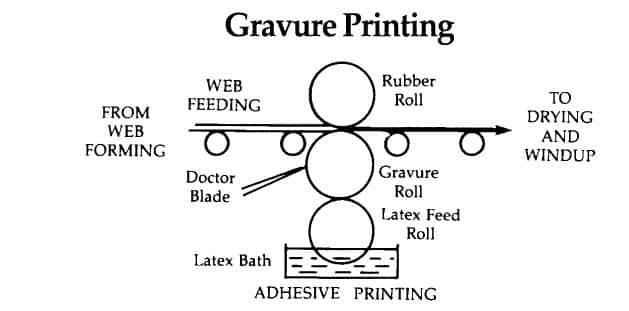
Gravure printing or bonding
In the context of nonwoven web bonding, this refers to a method of
bonding a web of fibers using the gravure method of printing. The gravure system uses a solid roller that is
engraved with numerous small indentations. In the bonding process, the roller is partially immersed into an adhesive
resin solution. As the roller turns, the excess solution is removed by a doctor blade, which leaves only the
adhesive binder solution in the roller’s indentations. An unbonded web is then squeezed against the gravure roller
(generally by a rubber roller) and the resin penetrates the web by osmosis. The web is then dried to remove the
water and the binder remains (See Resin Bonding).
Gray fabric
Same as greige.
Greige fabric
Generally refers to woven or knitted fabrics off the loom prior to bleaching,
dyeing or finishing treatment. The term is occasionally used to describe nonwovens before a finishing treatment.
gsm
Grams per square meter.
gsy
Grams per square yard.
H
Hand
Qualities of a fabric perceived by touch, e.g., softness, firmness, stretch, resilience and
drape.
Heat resistance
The ability to resist degradation at high temperatures. The retention of useful
properties when measured during heat exposure.
Heat setting
Process by which fibers, yarns or fabrics are heated to a final crimp or molecular
configuration so as to minimize changes in shape during use.
Heat stabilized
The ability of a yarn or fabric to resist shrinking or stretching under
mechanical or chemical stress. This property is obtained by prior heat-treatment or by use of a chemical additive.
HEPA filter
The acronym for High Efficiency Particulate Air. These filters are designed for
filtering gases, normally air, to an efficiency of 99.97% by trapping particles down to 0.3 microns in the DOP test.
Highloft
General term for low density, thick or bulky fabrics, as compared to flat, paper-like
fabrics. It is characterized by a high ratio of thickness to weight per unit area. Highloft battings have no more
than 10% solids by volume and are greater than 3 mm (0.13 inch) in thickness.
Holes
Small perforations or openings of varying sizes in a fabric.
Hollow filament fibers
Manmade, continuous filament fibers, with voids created by introduction of
air or other gas in the polymer solution or by melt spinning through specially designed pinnerettes.
Hot-melt adhesive
A solid material that melts quickly upon heating, then sets to a firm bond upon
cooling. Used for almost instantaneous bonding.
Housewrap
A layer of material used on new building construction to prevent air leakage, thereby
reducing heating and air conditioning costs and increase comfort. It is installed in the exterior walls of a new
building construction prior to adding the building’s final exterior. Housewrap is designed to be semi-permeable and
allows water vapor to migrate through it thereby reducing the possibility of interior wall damage due to moisture
build-up.
HVAC
The acronym applies to Heating, Ventilating and Air Conditioning systems that service air in
an enclosed space, i.e., buildings, airplanes, cars, etc.
Hybrid
A nonwoven produced by incorporating the advantages of two or more nonwoven manufacturing
systems to produce specialized nonwoven structures with properties unattainable by any single nonwoven process.
Hydroentangling, Hydroentangled
See Spunlace bonding.
Hydrophilic
Having an affinity for being wetted by water or for absorbing water.
Hydrophobic
Lacking the affinity for being wetted by water or for absorbing water.
Hydroscopic, hygroscopic
The ability to absorb moisture from the atmosphere, a property that
fibers have in varying degrees.
I
Ignition
The beginning of combustion.
Imbibition
Liquid holding capacity of a fabric.
Impingement
The process in which particles are removed from an airstream because of the inertia.
As an air containing particle flows toward a filter fiber or other collecting surface, the particle does not follow
the air streamlines because of its inertia. Instead it moves in a straight line, colliding with the filter fiber or
surface to which it may become attached.
Industrial fabrics
Textiles for non-apparel and non-decorative uses. Examples are wipers, cable
wrappings and geotextiles.
Initial modulus
A material’s resistance to small deformations, defined as the slope of the stress
strain curve at the origin and sometimes used to indicate fiber stiffness.
Instron tensile tester
High precision electronic test instrument that measures the elongation,
tensile strength, tear strength or resistance to compression of materials while pulling or compressing forces are
applied.
Interfacing (Interlining)
A fabric used in garments, to provide weight, thickness (or body) and
stability.
Inertia
Any physical body persists in its present state of rest or moving in a straight line
motion unless acted upon by some external force.
ISO
Acronym for the International Standards Organization based in Switzerland.
Isotropic
A fabric having the same physical properties in every direction in the plane of a
fabric. It is related to random distribution of fibers in a fabric.
J
J-box
A “J” shaped temporary holding or collecting area used in continuous fabric processing. The
fabric from one piece of machinery is fed into the top of the Jbox. The fabric fan folds and will be extracted from
the bottom of the J to go into the next step of the process.
Jaws
The component of the clamp that grips the test material.
Jute
Soft fibers from the inner barks of certain tropical plants.
K
Kieselguhr
Having the same physical properties in every direction in the plane of a fabric. It is
related to random distribution of fibers in a fabric.
Knitted fabric
A fabric made from yarns or filaments that have rows of loops that interlock with
the following row.
Knitting
A method of producing a fabric by interlocking a series of loops of yarns or filaments.
There are two basic knitting methods:
- Weft Knitting – A method of knitting in which one yarn or filament is interlooped with the previous course of loops made by the yarn. Circular knitting is a common method of weft knitting.
- Warp Knitting – A method of knitting in which the yarns or filaments run in the machine direction. This system uses large spools of yarns or filaments (warps). Three different methods of warp knitting are tricot, raschel and milanese.
L
Laminate
A layered material containing two or more sheets bonded together with an adhesive, foam
or thermoplastic resin.
Laminate nonwoven
A laminate of two or more layers of material in which the essential component a
nonwoven material.
Lap
A compressed sheet of fibers in a roll form, weighing about 50 pounds. The fibers are not
bonded and used to supply fibers to a card. Also called picker lap.
Lap splitting
A condition caused by a lap which will not unwind in carding in the same thickness
as it was wound in picking. This splitting of the sheet of fiber can result in either a thicker or thinner sheet
being fed into the card.
Latex
Either a naturally occurring milky appearing fluid from which rubber is made or a
dispersion of a synthetic polymer in water. Typically used as binders.
Latex Bonding
See Resin Bonding.
Lengthwise
The machine direction in which the fabric is produced.
Lickerin
This is at the beginning of the fiber feed system of a card line. It is a high speed,
saw-toothed wire roll that grabs the tufts of fibers fed into the system and deposits the partially opened fibers
onto the main card cylinder.
Lickerin loading
A condition that can occur with the lickerin where fiber can become imbedded in
the saw-toothed wire reducing the lickerin’s ability to grab fiber and transfer it to the main card.
Limiting oxygen index
Measure of flammability that determines the minimum concentration of oxygen
in a gas mix that is required to sustain steady burning.
Lint
Particles and short fibers that fall off a fabric product during the stresses of use.
Linters
Short cotton fibers not removed from the cottonseed after the spinnable fibers are
removed on first pass through the gin. Linters are cut from the seed. Linters are used to make cellulose-based
chemicals and rayon.
Loft
The properties of bulk and resilience of a fabric or batt.
Long staple
A long fiber. Typically used to describe the length of fibers used in the wet forming
process by the paper industry.
Long-life nonwoven
Synonymous with Durable nonwoven.
Lubricant
Oil or other substance added to fibers to improve their processability in carding.
M
Machine direction
The long direction within the plane of the fabric that is in the direction in
which the fabric is being produced by the machine.
Man-made fibers
Another term for synthetic fibers.
Married fibers
A term used to describe bundles of unopened fibers of a carded or spunlaid
nonwoven. Married fibers are most noticeable in lightweight fabric.
Matrix
In the context of the nonwoven industry, this manufactured fiber that is made from two or
more dissimilar polymers combined before or during extrusion. These polymers separate into random components during
extrusion. The bicomponent fibers could be used in through-air bonded processes.
Mechanical bonding
Bonding a web of fibers by entangling them. This can be achieved by needling,
stitching them with fibers or by entangling them by high-pressure water jets.
Mechanical finishing
Changing the appearance or physical characteristics of a fabric by a
mechanical process such as calendering, embossing, bulking, compacting and creping.
Media area
The total surface area of media used in the production of a filter. Net effective: The
measure of usable media in a filter.
Medium
Medium is synonymous with filter material. “Media” is the plural of “medium.” It is common
today to use media as the singular and “medias” as the plural.
Melt blowing
A nonwoven web forming process that extrudes and draws molten polymer resins with
heated, high velocity air to form fine filaments that are deposited onto a moving screen. In some ways the process
is similar to the spunbond process, but melt blown fibers are much finer and generally measured in microns. Melt
blowing is a spunlaid process. The term is also spelled “meltblowing”.

Melt blown nonwoven
A melt blown web that has been bonded by one or more techniques to provide
fabric integrity.
Melt blown web
A web produced by melt blowing.
Melting point
The temperature at which a solid changes to the liquid state.
Melt spinning
The process of passing a liquid (molten) polymer through spinnerets and coagulating
the material into fibers in a cooled air stream. See related processes: Melt Blown, Flashspinning and Spunbond.
Membrane filter
A permeable or semi-permeable membrane made of metal, polymer or other materials.
These filters are capable of separating micron and sub-micron size particles from liquids and gases.
Meter (metre)
An SI linear measurement equal to 39.37 inches. Metre is the preferred spelling in
many world regions. Multiply the value by 1.196 to convert square meters to square yards.
Metering pump
A component of the spinning process that measures the volume of molten polymer sent
to a spinneret.
Methenamine test
A standard flammability test used to measure flame retardancy of traditional
textiles and nonwovens. In a controlled environment, the methenamine tablet is ignited on the test sample and the
amount of charring and burn is measured.
Micron
It is a unit of measure and equivalent to one millionth of a meter. In the context of
nonwovens, the micron unit of measure is generally used to describe the width of low denier fibers, such as melt
blown filaments. The abbreviated form is µ.
Mil
It is a unit of measure equal to one thousandth of an inch. Commonly used to measure the
diameter of fibers and the thickness of films.
Mildew resistance
The degree to which fabrics are unaffected by certain fungi that cause odor and
discoloration.
Mist
An aggregate of fine droplets of a liquid suspended in the air or a cloud of particles
forming a haze.
Modulus
The amount of force it takes to stretch a material a unit distance. It is a measure of
elasticity. An extensible material or fiber has a low modulus. Stiff materials have a high modulus.
Moisture content
The amount of moisture in a material expressed as a percentage of the material
after drying.
Moisture regain (or Regain)
Percentage of moisture in a fiber or fabric after it is equilibrated
in a standard humidity and temperature.
Mold
A variety of fungus growths commonly found on the surface of damp decaying organic matter or
in warm moist places. It is characterized by a woolly or furry texture.
Molecule
The smallest part of an element or compound that can exist separately without losing its
chemical properties.
Molten
A material in the liquid state or melted.
Monofilament
A single filament of fiber.
Monomer
A chemical compound that can be polymerized.
Morphology
Study of the fine, microscopic structure of a fiber or other materials, e.g., its
crystalline and amorphous nature.
N
Nap
The soft raise fibers of a textile achieved by a brushing the fabric.
Natural fibers
Fibers made directly from animals, vegetables or minerals. Examples are silk,
wool, cotton, flax, jute, ramie and asbestos.
Necking
The narrowing of a fabric when stretched.
Needle
In the context of the nonwoven industry, the term refers to the barbed needle used by the
needlepunched technology. The needles hook the fibers and perform the interlocking function. There are many
variations in needle design, barb placement, barb angle, barb shape depending upon the fiber and desired product
outcome.

Needle beam
The component of the needlepunched technology that supports the needle board. The
needle beam oscillates generally in and up and down movement penetrating the needle board into the web.
Needle board
In the needlepunched technology, the needle board is the part of the needle loom to
which the barbed needles are anchored. The needle board is fastened to the needle beam.
Needlepunched or Needlepunching
Mechanically binding a web to form a fabric by penetrating the
web with an array of barbed needles that carry tufts of the web’s own fibers in a vertical direction through the
web.

Neps
Small knots of tangled fibers that were not separated before forming the web.
Nip
The line of close contact between two calender rolls between which a fabric or web passes.
Nonwoven fabric
A primarily fibrous assembly — other than a
traditional paper, woven, or knit — which has been engineered to some level of structural integrity by physical
and/or chemical means.
Nozzle
A term occasionally used in reference to the spinneret of a spunbond production line or
fiber spinning system.
Nylon
See Aramid.
O
Olefin fiber
Any synthetic fiber made from long molecular chains of propylene, ethylene or other
olefins. These fibers are used widely by the nonwovens industry in disposable and durable end uses, which include
cover stock, automotive, geotextiles, medical apparel, home furnishings and bedding (See Polypropylene fiber).
Oleophilic
A substance that has an affinity to oil (see Sorbent).
Oleophobic
Opposite to the term Oleophilic. The substance has little to no affinity for oil.
On-stream
See Start-up.
Opener
See Bale Breaker.
Opening
A preliminary operation whereby staple fiber is separated sufficiently from its lap or
baled condition so that it can be fed to the web forming part of the process.
Openness
A term describing how tightly or loosely packed a collection of fibers is in any space.
Optical brightener
A colorless compound that contributes whiteness to fabric. It does this by
absorbing the ultraviolet component of light and emitting it as visible light.
Organic
Compound molecules that contain one or more carbon atoms.
Orientation
- The lining up or parallelism of molecular chains in fibers and films
- The alignment of fibers in a nonwoven material
Overlap
Refers to the area where the web from one pass of a crosslapper lays over the edge of the
previous lay.
Ozone
Ozone is a gaseous, unstable form of oxygen that is composed of three atoms rather than
two. Ozone is a powerful oxidizing agent and is toxic even at low levels. It is a component of smog.
P
Padding
Applying a liquid or paste to a textile by dipping it in a bath or by passing it between
squeeze rollers that carry the liquid or paste.
Parallel laying
Forming a web in such a way that the fibers or filaments are laid in directions
roughly parallel with the machine direction.
Particle
A minute piece, part or portion of matter. It may be solid, semi-solid or liquid.
Peak force
A term used in tear testing. It is the force required to break the fiber bonds of a
nonwoven or other samples textile materials.
Particle count
The quantity of particles in a given volume of fluid.
Penetration
The flow of a liquid through pores, pinholes or holes resulting from imperfections or
degradations of a fabric.
Penetration (filtration context)
A measure, in percent, of particles of a given size that pass
through a filter. If no particles pass through then 100% were trapped. If 97% of particles are trapped, then
penetration is 3% (100% – 97% = 3%) and the filter is 97% efficient. Penetration is used to measure the performance
of very high efficiency filters.
Permanent press
Treatment for garments that permits them to retain their shape, creases or pleats
after laundering.
Permeation
The passage of liquids or gases through materials by absorption and diffusion on a
molecular level and exiting as a gas.
Physical property
The response of a fiber to physical forces.
Picker
A machine that separates staple fiber and forms it into a lap, so it can be fed to a card.
Pigment
A colored or white substance that is insoluble and finely divided. Used to color or to
deluster a fiber, fabric or plastic.
Pilling
The tendency of fibers to come loose from a fabric surface and form balled or matted
particles of fiber.
Pinsonic thermal joining
A process which uses ultrasonic energy to bond layers of thermoplastic
materials.
Plastic
A polymer with its additives. Also, the ability to be deformed and molded.
Plasticizer
Chemical that imparts flexibility, stretch and workability to a fiber or a plastic.
Pleating
The process of fan-folding materials to increase surface area. Commonly used for filter
media to increase efficiency and pressure drop.
Plies
Layers of web, fabric or components of a laminate.
Point bonding
Using heat and pressure in a discrete pattern to bind thermoplastic fibers to form
a nonwoven fabric.
Polyester fiber
A manufactured fiber in which the fiber-forming substance is any long chain
synthetic polymer composed of at least 85% by weight of an ester of dihydric alcohol and terephthalic acid (FTC
definition). The physical properties of polyester fiber are excellent strength, high abrasion and resilience with
good chemical resistance to acids, solvents and oxidizing agents. Major end uses for polyester staple fiber are
fiberfill, wipes, and durable nonwovens, such as geotextiles, automotive and carpeting. Spunlaid polyester is found
in fabric softener substrate, automotive carpeting, modified bitumen roofing and various durable end-markets.
Polymer
A liquid or solid substance made by chemically linking macromolecules together in chains.
High polymer denotes substances made from very long chains. Crosslinked polymer
describes a substance in which there are molecular links between chains. Polymerization is
the process for making these polymers.
Polymerization
The process of changing the molecular arrangement of a compound so as to form new
compounds having the same percentage composition as the original, but of greater molecular weight and different
physical properties.
Polymer laid nonwoven
See Spunlaid.
Polyolefin
A fiber made of long-chain polymerized olefin of at least 85% weight, from such
monomers as ethylene, propylene or other olefins.
Polypropylene fiber
A manufactured, olefin fiber made from polymers or copolymers of
polypropylene. One attractive physical characteristic of polypropylene is its specific gravity of less than one,
which results in a larger area volume yield per kilogram or pound of resin or staple fiber compared to competitive
fibers. Polypropylene has a relatively low melt temperature which restrict its uses in many nonwoven markets, but it
has good strength properties, softness, and chemical resistance to strong acid and alkalis. Major nonwoven markets
for staple and spunlaid polypropylene include cover stock, medical apparel and related, geotextiles, carpeting,
blankets, automotive and various other durable markets.
Pounding
A process wherein a batt of fibers is repeatedly struck with a hammer-like device to
drive wool fibers into the web resulting in entangling the fibers.
ppm
An abbreviation that refers to “parts per million.” It may be expressed by volume as ppm (v)
or by mass as ppm (m).
Precipitation
The action of a solid or liquid separating from a solution because of a chemical or
physical process or change that has rendered it insoluble.
Pressure drop
The pressure drop is the resistance to a fluid passing through a filter media at
various flow rates.
Primary backing
The fabric into which a carpet is tufted.
Print bonding
Applying a latex resin binder to a web of fibers in a discrete pattern. See
Screen Bonding and Gravure Bonding as the
application methods.
Pulp
Short cellulose fibers made from wood or cotton.
Q
QA
Acronym for Quality Assurance.
Quality control or assurance
Maintenance of standards in products or services through testing and
procedures.
Quenching
Cooling of filaments after extrusion by carefully controlled airflow.
R
Random laying
Forming a web in such a way that the fibers or filaments are laid in essentially
random directions. This is accomplished by using an air laid or wet laid process.
Random laid nonwoven
A random laid web bonded by one or more bonding techniques to provide fabric
integrity.
Random laid web
A web in which the fibers are laid in essentially random directions.
Rated filter capacity
The specific quantity of fluid that a filter manufacturer recommends can be
handled by the filter.
Rayon fiber
A manufactured fiber composed of regenerated cellulose, as well as manufactured
fibers composed of regenerated cellulose in which the substitutes have replaced not more than 15% of the hydrogen
atoms of the hydroxyl group (FTC definition). Rayon is manufactured from the cellulose found in vegetable matter,
the major source being wood pulp and cotton linters. The cellulose is dissolved into a viscose solution and then
extruded through a wet-spinning system to coagulate the filaments. The principal physical properties of rayon is
moderate strength, softness, luster, hydrophilic and ease of dyeing. The major nonwoven market is wipes.
Reconstituted fibers
Fibers made from recovered waste polymer or blends of virgin and recovered
waste polymer.
Relaxation
The decay or relaxation of stress exhibited by a material when held at constant
strain.
Repellency
The ability to resist wetting and staining by materials and soils.
Resilience
The area under the stress-strain curve from the origin to the yield point.
Resiliency
Ability of a fiber or fabric to spring back when crushed or wrinkled.
Resin
Any of a group of solid or semi-solid materials made by chemical synthesis. The materials
are often used in plastics or production of synthetic fibers (see Polymer).
Resin bonding
A common method of web bonding by using chemical agents, which may include adhesive
resins and solvents. Most common is resin bonding. Latex resins (adhesive) are applied to the web by a variety of
methods: dipping the web into the latex and removing the excess, spraying, foaming or printing bonding. The resin is
usually in a water-based solution, so this bonding process requires heat to remove the water to dry and set the
binder into the fabric. This is sometimes referred to as “latex bonding”.
Reworked fibers
Fibers that are sourced from several areas and recycled into needlepunched
materials often destined for padding or insulation. This material is often referred to as “shoddy”.
Roll goods
Fabric rolled up on a core after it has been produced. It is described in terms of
fabric weight and the width and length of the material on the roll.
S
Saturation bonding
A web bonding technique that saturates a web with an adhesive binder followed
by drying and curing.
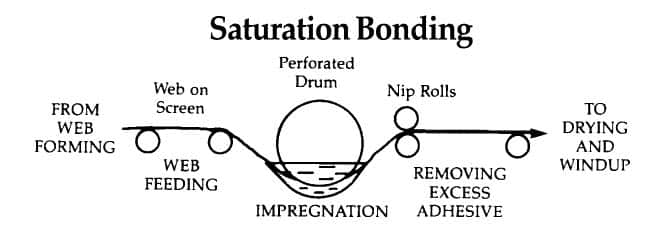
Screen printing or bonding
In the context of nonwovens, this usually refers to a method of resin
bonding a web of fibers. A cylindrical screen containing a latex resin binder is rolled and pressed against a moving
web of fibers. As the cylinder rotates against the web, adhesive binder is squeezed into the web. The binder is then
dried by heat thereby bonding the web. See Resin Bonding for further information.
An advantage of screen bonding (sometimes referred to as latex printing) is that the amount of binder squeezed onto
the web can be controlled by the pattern and hole sizes in the screen. Color pigments can be added to the binder and
this bonding method is often used to print end products, such as colored wipes.
Scrim
A textile with an open structure, which may be woven or nonwoven, added to reinforce weaker
materials.
Scroop
The term refers to the characteristic crunch when loose, bleached cotton is hand squeezed.
The sound is described as the crunch of walking on fresh fallen snow.
Seam strength
The ability of a fabric to hold a seam against tension.
Seaming
Joining the overlap of two pieces of fabric, usually near their edges.
Secondary backing
A layer of material laminated to the underside of a carpet to lock in carpet
tufts, improve abrasion resistance, dimensional stability and strength.
Seconds
Imperfect roll goods that have various flaws, such as weight lower or higher than
specified, poor bonding, inconsistent web formation, poor tensile strength and many more.
Short fiber
Staple fiber less than 0.5 inches long. Typically used in wet laid processes, to make
fabrics, or as fillers in the absorbent cores of disposable diapers.
Short-life nonwoven
Synonymous with Disposable nonwoven.
Shrinkage
A reduction in length or width due to the effect of heat, moisture or chemical action.
Sintering
The process of adding a dry adhesive to a web and heating the web to the point that the
adhesive melts and flows to bind the web once cooled. The sintering process is commonly done as a finish to apparel
interlining. The sintered interlining will adhere to the apparel fabric when reheated.
Sisal
A tropical plant by the same name with fibrous leaves that are used to make rope and other
miscellaneous products.
Smog
A mixture of gases and aerosols generated from a variety of sources, such as automobiles’
exhaust, burning coat for electricity generation and discharges from many industrial processes. Smog can contain
noxious substances and acids that have a damaging effect to the environment and respiratory organs.
Smoke
An aerosol of particles usually solid formed from combustion of organic materials, such as
wood, coal, oil, etc. It usually refers to the soot or carbon particles less than 0.1 mm, which results from
incomplete combustion.
Smouldering
A slow, flameless, smoking burning of a fabric.
Solution-dyeing
Adding pigments or insoluble dyes into the polymer melt or spinning solution
prior to extruding a manmade fiber.
Solution spinning
See Dry Spinning.
Sorbent
A nonwoven fabric used to attract and/or contain fluids. The term is most commonly used
to describe products that are used to clean-up environmental oil spills and around machinery in a workplace to
capture oil and other fluids. Oleophilic fibers, such as from polypropylene, are widely used in these products.
Specific gravity
Ratio of the mass of a material to the mass of an equal volume of water at 4oC.
Spin finish
A lubricant applied to fibers to reduce friction and static during processing into
yarns and fabrics.
Spinning
A process by which filaments or fabrics, made from filaments, are generated directly by
passing a molten polymer through a spinneret.
Spinneret
A disc or plate containing many small holes through which molten polymer is extruded to
form filaments. Spinnerets are used in the spunlaid process or production of filaments. Occasionally the spelling is
“spinnerette”.
Spray bonding, Spray bonded
A method of binding fibers to form a fabric. The adhesive binder is
sprayed onto the web of fibers and subsequently dried and cured (See Resin
Bonding).

Spreading
Generally refers to the method of increasing a web’s width, wider than the card’s
width, prior to bonding and altering fiber orientation in nonwoven fabric production.
Spunbond, Spunbonded
A spunlaid technology in which the filaments have been extruded, drawn and
laid on a moving screen to form a web. The term is often interchanged with “spunlaid”, but the industry had
conventionally adopted the spunbond or spunbonded term to denote a specific web forming process. This is to
differentiate this web forming process from the other two forms of the spunlaid web forming, which are melt blown
and flashspinning.
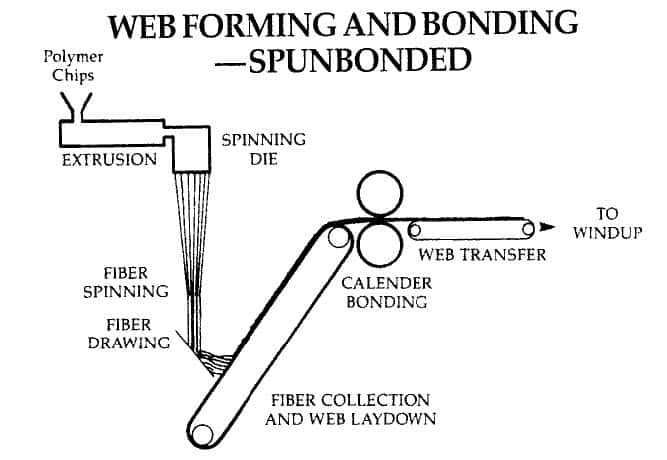
Spunbond nonwoven, Spunbonded nonwoven
A fabric formed from spunbonded process that has been
bonded by one or more methods to provide fabric integrity.
Spunbond/Melt blown composite
A multiple layer fabric that is generally made of various
alternating layers of spunbond and melt blown webs: SMS, SMMS, SSMMS, etc.
Spunlace bonding, Spunlaced bonding
The method of bonding a web by interlocking and entangling
the fibers about each other with high velocity streams of water (synonymous with Hydroentangling).
The web or fabric may have other bonding methods in addition to spunlacing. Spunlacing, not to be confused with
spunlaid, is generally produced from a web made up of staple fibers from a dry formed, carded system, but small
quantities of spunlace bonding are done on production lines that use a wet laid forming process. A recent technical
development is the production of a spunlaced nonwoven from a spunlaid, continuous filament web.

Spunlace nonwoven, Spunlaced nonwoven
A fabric produced by the spunlace technology. Spunlace is
synonymous with hydroentangling.
Spunlaid
A web forming processes where the production line extrudes and supplies its own fibers
from a molten polymer in one continuous process. Melt spun forming processes include spunbond, flash spinning and
melt blown. The most common polymers used are polypropylene, polyester and polyethylene.
Staple fiber
Refers to natural or synthetic cut fibers. The work “staple” is used by the textile
industry to differentiate cut fibers from continuous filament fibers, such as that used in the spunlaid process.
Synthetic staple fibers used in the needlepunched process are generally about 3.8-4.8 cm in length. The fiber
lengths of natural fibers, which include wool, cotton, choir, jute and several others, vary considerably.
Start-up
The time when a new production line is finally put into commercial production after the
production line is commissioned. This term is synonymous with “onstream”.
Static
An accumulation of electrical charge on the surface of fibers or fabrics due to its
inadequate dissipation during processing or use.
Statistic
A quantity that is calculated from observations on a sample and that estimates a
parameter of a population.
Sterilizing filter
A filter that uses a media of sufficient fineness to remove bacteria. These
are usually membrane or depth filters.
Stiffness
The ability of a fabric to resist bending. It is related to fiber modulus or
elasticity.
Stitch bond, Stitch bonded
A technique in which fibers in a web are bonded together by stitches
sewn or knitted through the web to form a fabric. The finished fabric usually resembles corduroy.

Stitch bond nonwoven
A nonwoven produced by the stitch bonding process.
Stress-strain curve
Graph showing the amount of stretch or compression obtained as a function of
the force applied and the point at which rupture or breakage occurs.
Stretch
The ability of a fabric to grow in length when pulled.
Substrate
Fabric to which coatings or other fabrics are applied.
Superabsorbent
A sorbent material that can absorb many times the amount of liquid ordinarily
absorbed by cellulosic materials, such as wood pulp, cotton and rayon.
Surface charge
Electrical charge on a fiber or fabric.
Surface energy
The work necessary to increase the surface area of a liquid – generally expressed
in dynes per square centimeter. Dynes are units of work.
Surface filter
A thin filter material that retains contaminants on the surface.
Surface tension
Forces acting between the molecules making up the surface of a liquid, causing
the surface to contract to a minimum. Since it is a measure of the attraction of a liquid for itself, it can be
related to its ability to mix with other liquids or to wet other surfaces.
Surfactant
A chemical additive that changes the surface attraction between two liquids, or
between a liquid and a solid, by changing the surface energy of one or both components.
Swelling
Expansion of a fiber caused by exposure to a solvent or chemical agent.
Synthetic fiber
A man-made fiber, usually from a molten polymer or from a polymer in solution.
T
Tackifier
A viscous substance; usually oil, pressure sensitive resins or solvents, which are
applied to the surface or throughout a filter media to increase the retention of dust.
Tear strength
Resistance of a material to being torn.
Technical textile
A general term used to describe a broad range of textiles that are designed for
specific applications. These textiles include nonwovens, wovens, knits and film composites. The types of
end-products usually associated with technical textiles are nonwovens and certain woven, knitted and film fabrics
used in products, such as protective apparel (hazardous waste, fire, clean room, military, etc.), parachutes,
“hi-tech” tenting materials, flags, automotive interior fabrics and housewrap – to name a few.
Tenacity
A measure of the strength of a fiber. The force exerted per unit linear density when
tensile stress is applied. Expressed as grams of force per denier or newtons per tex. Newtons are
units of force.
Tenacity
The specific stress at the breaking point.
Tensile strength
The strength of a material when subjected to either pulling or to compressive
stress. It measures the stress a material can bear without breaking or tearing.
Test method
A procedure for the identification, measurement, and evaluation of one or more
qualities of a material, product, system or service that produces a test result.
Tex
A metric measure of the weight per unit of a fiber. It is numerically equal to the weight in
grams of one kilometer (1000 meters) of the material. It is also equal to the denier divided by 9 (see Denier).
Texturing
A process for imparting crimp, crepe and bulk to fibers, yarns and fabrics.
TFPIA
Textile Fiber Products Identification Act (approved by the U.S. Congress in 1958 and most
recently amended in 1998). This legislation was intended to protect producers and consumers against misbranding and
false advertising of the fiber content in textile fiber products. In addition to establishing generic names and
definitions for manufactured fibers, the Act also sets forth labeling regulations and tolerances for fiber content.
Thermal bonded/Thermobonded
A web of fibers bonded by a thermal bonding (thermobonding) process.
Thermal bonding/Thermobonding
A technique for bonding a web of fibers in which a heat or
ultrasonic treatment, with or without pressure, is used to activate a heat-sensitive material. The material may be
in the form of homofil fibres, bicomponent fibers, fusable powders, as part of the web. The bonding may be applied
all over (e.g. through or area bonding) or restricted to predetermined, discrete sites (e.g. point bonding).
Thermoplastic
A plastic that melts when heated.
Thermoset
A plastic, once formed, that does not melt when reheated.
Thickness
The dimension of a sheet or lamina measured perpendicular to the plane of the sheet.
Through-air bonding
A bonding system that that uses high temperature air to fuse the web’s
fibers. There are two basic systems: blowing hot air through the web in a conveyor oven or passing heated air
through the web on a rotating drum (illustrated below). Fabrics made from bicomponent fibers or blends of
bicomponent and regular fiber are often bonded by through-air bonding systems. This method is sometimes referred to
as air-through bonding.

Throughput
Amount of output or production per unit time.
Ticking
Strong fabric used as a covering for a mattress or pillow and in upholstery.
Titanium dioxide
A natural chemical compound (TiO2) often used to pigment polymers in the
spinning process to add whiteness.
Tolerance
The permitted variation in the measurement of specified property, such as weight,
strength, color, etc., that is being observed in a test method.
Top sheet
The cover stock that is the first layer inside the diaper that touches the body. The
material is permeable allowing body fluids to pass through to the diaper’s core leaving a dry surface in contact
with the wearer’s skin.
Torsional rigidity
The resistance of a fiber to twisting, defined as the couple required to twist
a fiber of unit length to unit angular deflection or the torque required to cause unit twist.
Toughness
The energy-absorbing capacity of a fiber, defined as the specific work of rupture and
obtained by measuring the area under the stress-strain curve.
Tow
A bundle of continuous filaments – the form of most man-made filaments before being cut into
staple.
Transition temperature
A temperature at which some radical change, usually a phase change, in the
appearance or structure of a substance occurs.
Tricomponent fiber
A fiber that is made from three polymers that are physically or chemically
different.
Tufted carpeting
A pile carpeting produced by a tufted process. In the process, fibers are
carried by a series of needles and thrust through the carpet backing to be held in place by the backing as the
needles are withdrawn. Nonwoven materials are used as primary and secondary carpet backing for some applications,
often in automotive and modular carpeting.
U
ULPA
The acronym for Ultra Low Penetration Air (filter). Air filters made to ULPA standards have
filtration efficiencies of 99.999% on 0.3 micron DOP particles.
Ultrasonic bonding
The use of high frequency
sound to generate localized heat through vibration and cause thermoplastic fibers to bond to one another.
Ultraviolet absorbers
Various chemicals or
polymers added to the product that absorb the ultraviolet light or otherwise make the material resistant to
ultraviolet degradation.
Ultraviolet resistance
The ability to retain
strength or other properties upon exposure to ultraviolet light.
Ultraviolet stability
Degree of a material’s
resistance to degradation by ultraviolet rays.
Ultraviolet degradable
The ability of a substance
to be broken down by the action of the ultraviolet part of the light spectrum.
Unbonded
A fiberfill material that has not had
any form of bonding treatment.
Underlay
A layer of material, such as foam, felt,
rubber padding, placed under carpeting or rugs to provide cushioning and increase service use.
Unidirectional fabric
A fabric having strength
mostly in one direction, generally the machine direction.
U.V.
Ultraviolet rays.
V
Van der Waals forces
The forces of attraction and repulsion between molecules caused by the
electric fields of the electrons (negative) and the nuclei (positive). The forces of molecular attraction explain
why particles adhere to a filter’s fiber.
Vapors
A substance in the gaseous state which is usually in a liquid or solid state.
Virus
A semi-living, generally inert microscopic particle chiefly protein in composition. They
replicate by entering a living cell and direct the cell to reproduce more viruses. The cell is usually destroyed as
the new viruses are released to the surrounding environment.
Viscose fiber
See Rayon Fiber.
W
Warp
The yarns that run in the machine direction of a woven fabric.
Warp knitting
See Knitting.
Wash and wear properties
Ability of a fabric to retain its strength and appearance after repeated
washings and dryings.
Water repellency
The ability to resist wetting by water.
Weak web
A term generally used in the context of web formation in a carding process. It refers to
the low cohesion of the fibers to one another and thus the web does not have the strength to transfer from one
working component to another in the carding process. This situation can be caused by a number of factors, such as
poor fiber finish or lack humidity problems.
Wear test
A test that evaluates a fabric’s properties in actual use through laundering, cleaning
and other wearing conditions.
Web
A sheet made by laying down and assembling fibers or by creating holes or cracks in a plastic
film.
Web consolidation
See Bonding.
Weight
The mass of a fabric expressed in grams per square meter or ounces per square yard.
Wet laid definition
To distinguish nonwovens from papers, a wet laid material will be defined a
nonwoven if:
- More than 50%, by mass, of its fibrous content is made up of fibers (excluding chemically digested vegetable fibers) with a length to diameter ratio greater than 300; or
- More than 30%, by mass of its fibrous content is made of fibers in “a” above and meet one or both of the
following criteria:
- Length to diameter ratio of more than 600
- The density of the fabric is less than 0.4 g/cc
Wet laying or Wet forming
Wet laid nonwovens are produced in a process similar to paper making.
The nonwoven web is produced by filtering an aqueous suspension of fiber onto a screen conveyor belt or perforated
drum. Many wet laid nonwovens are made with wood pulp or other natural blended with synthetic fibers or fiberglass.
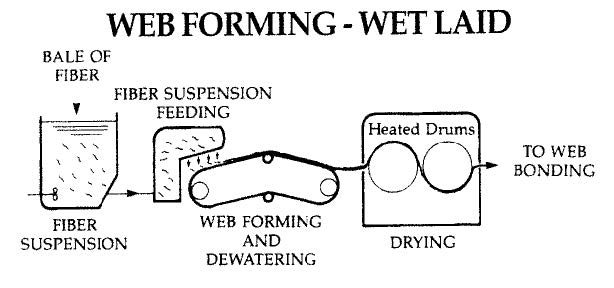
Wet laid nonwoven
A wet laid web bonded by one or more techniques to provide fabric integrity.
Wet laid web
A web of fibers produced by the wet laying process.
Wet spinning
The process of passing a fiber forming polymer through spinnerets and coagulating
the polymer into fibers in a chemical bath.
Wet strength
The resistance of a fabric to being torn when it is wet. Usually compared to its
strength when dry.
Wetting agent
Additive adsorbed to material surface that prevents water repellency and helps to
spread liquid on the surface.
Wicking
Transport of liquid within an absorbent fabric, vertically into the fabric web and
horizontally within the plane of the fabric.
Wood pulp
Cellulosic fibers used to make viscose rayon, paper and the absorbent cores of products
such as diapers, sanitary napkins and adult incontinence pads.
Wrinkle
A small crease or fold in a fabric which is generally short in length and usually
irregular.
Wrinkle resistance
The ability of a fabric to resist remaining creased, wet or dry, after it has
been crushed and compressed.
X, Y, and Z
Yarn
A continuous strand of fibers or filaments that are twisted together, to enable its
conversion into a woven, knitted or braided fabric.
Yield
The number of square meters (square yards) produced by a kilogram (pound) of fiber or
resin.
Yield point
The point at which a tangent to the stress-strain curve is parallel to a line joining
the origin to the breaking point.
Zwitterionic surfactant
A chemical additive bearing both positive and negative charges that
change the surface energy between two materials.